Take away three things
- Notice the question before choosing a solution.
- Keep the human situation attached to the technical problem.
- Give curiosity a method: observe, document, test and revise.
New website adaptation of the recovered book themes. The text here is newly written for this site.
The question comes before the system
A question often begins in an ordinary moment: why is this difficult, why does the same failure return, why does useful information disappear between people? Before it becomes a research brief, it is an attempt to understand an experience.
The recovered book project follows that movement from life into questions and, later, into systems and technology. Its useful lesson for the portfolio is that design starts with attention to what is happening.
What a question can become
Repeated observations can reveal a pattern worth investigating. The pattern then needs a careful description: who encounters it, under what conditions and what evidence would change the explanation?
This is where curiosity becomes structured work. A record of examples can become a source register. A recurring barrier can become a workflow map. A contradiction can become the starting point for a test.
A small practice to take away
Write down one question you keep returning to. Add a concrete example, the people affected and the information you would need before deciding what to change.
Keep the first explanation provisional. The purpose of the exercise is to create a better next question and a useful route to evidence.
Where this appears in the work
Discovery begins this way. ProvenResearch connects the question to evidence; Transformation Intelligence examines the surrounding system; Invention Intelligence explores a response when the existing options leave a demonstrated gap.
The idea in one view.
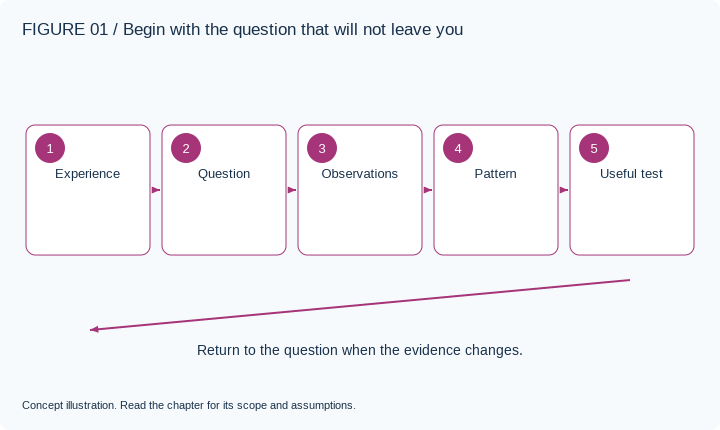
Conceptual explanation. The article states its assumptions and scope; illustrative inputs are identified within the figure.
From experience to a useful question
- Notice an experience
- Describe the question
- Investigate the pattern
- Choose what to test
A conceptual sequence. Follow the linked reading for context and boundaries.
Basis and scope
New website adaptation of themes recovered from the book project The Woman Who Asked Why and related founder writing. This is newly written editorial copy, not a verified passage from a latest manuscript.