Take away three things
- Capability and permission need separate records.
- Attach approval to the specific action and scope.
- Verify the outcome and retain exceptions.
Begin with a precise action
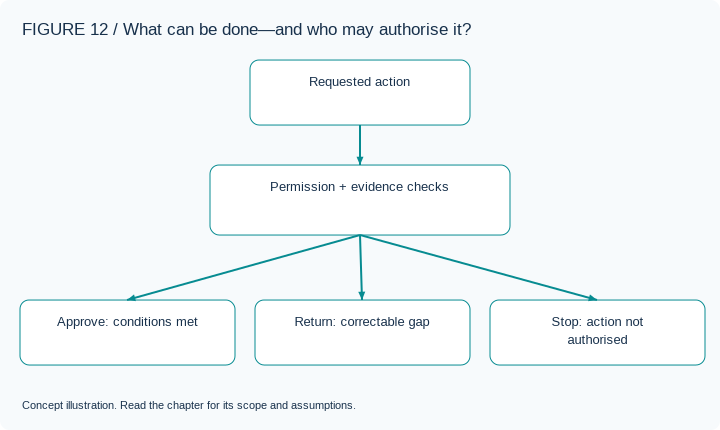
Reading a record, preparing a recommendation and changing an external system have different consequences. The workflow needs to identify the actual action requested.
Decision Intelligence considers feasible options and trade-offs. The authority check then establishes which role can approve or perform the selected action in the relevant context.
Carry the conditions with the task
A useful approval has a purpose and scope. Provider controls should be able to represent the required boundary; an incompatible or weaker control becomes a review item.
The latest multi-MCP direction makes this compatibility question explicit. A proposed connection cannot assume that every provider enforces the same policy in the same way.
Record what happened
The result needs an observable check. A tool response or companion saying “done” should be connected to the evidence of the external state where that can be obtained.
Denials, returns for correction and partial completion are legitimate outcomes to preserve. They help distinguish a bounded action from an unsupported claim of complete automation.
Make governance inspectable
For one consequential step, document the action, evidence, permitted role, approval conditions and expected result. Ask how the system behaves if any required part is missing.
The architecture is evaluated through those specific behaviours. It does not support a claim of universally perfect decisions or complete governance.
The idea in one view.
Conceptual explanation. The article states its assumptions and scope; illustrative inputs are identified within the figure.
Connect an action to authority and evidence
- Describe the action
- Check permission
- Apply review conditions
- Verify and record
A conceptual sequence. Follow the linked reading for context and boundaries.
Basis and scope
Public architectural synthesis of HumanGate, TrustMesh, the AIAI.science blueprint and the latest recovered multi-MCP direction reviewed 27 October 2026. These concepts are not a universal security or governance guarantee.