Take away three things
- Separate prediction from intervention.
- Expose the assumptions behind a causal explanation.
- Keep competing mechanisms visible when the evidence cannot choose.
Two questions that need different evidence
What tends to happen alongside a condition is a different question from what would happen if we actively changed it. A system can predict a pattern without identifying its cause.
Direction, hidden common causes and other structural assumptions can affect the proposed intervention.
What the exploratory work examined
The reviewed draft constructs multiple causal models that reproduce the same synthetic observational tables while giving different intervention predictions. The examples are exact counterexamples built to make the distinction visible.
They illustrate an established identification limit. They do not discover the mechanism behind a real dataset or evaluate an autonomous policy system.
How to use the distinction
Write down the proposed mechanism, the assumptions needed and alternatives compatible with the observations. Ask what new information or intervention could distinguish them.
Where a single effect cannot be justified, preserve a range of compatible possibilities and the assumptions that would narrow it.
The transformation connection
A workflow change should be connected to an explanation of why it might help and an observation plan for its wider effects. This gives a proposal a route to testing and correction.
The idea in one view.
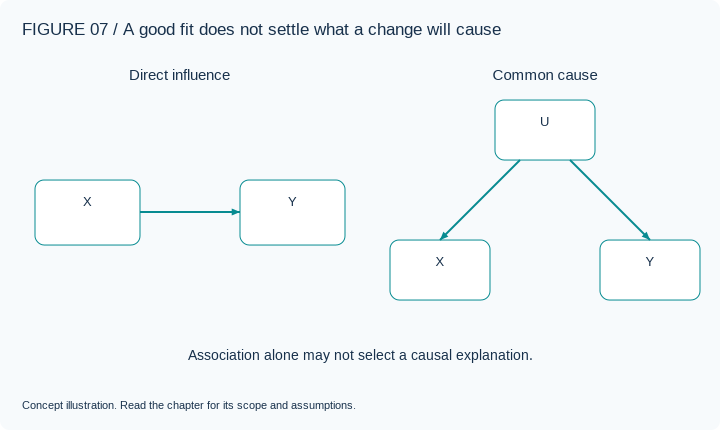
Conceptual explanation. The article states its assumptions and scope; illustrative inputs are identified within the figure.
The same association can fit different mechanisms
Conceptual alternatives. Observed association alone may not identify which mechanism is appropriate; additional assumptions or evidence are needed.
Basis and scope
Public explanatory note informed by exploratory UMT-Ω research drafts reviewed 27 October 2026. The underlying studies use synthetic constructions, are not peer reviewed or externally replicated, and do not evaluate the complete OMNI CORTEX architecture. No private draft or dataset is included here.