Take away three things
- Count information-generating events, not only documents.
- Record uncertain source relationships.
- Preserve genuinely independent evidence.
Trace the origin
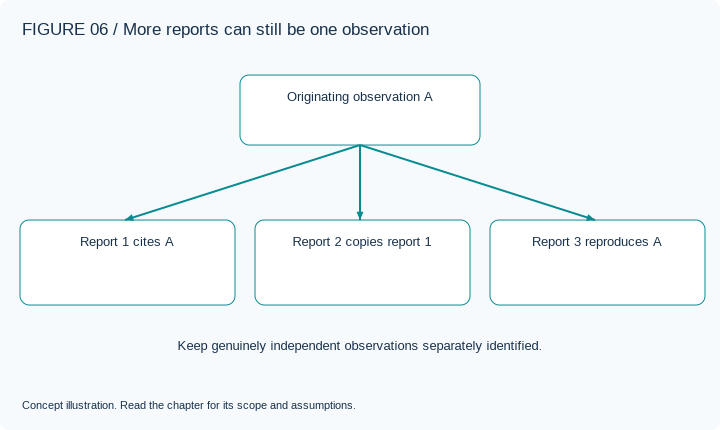
Several articles may repeat one original account. Several files may contain the same cached measurement. The documents are separate objects, but their evidential relationship matters.
Treating perfect copies as independent can create the appearance of stronger support without adding a new observation.
The reverse mistake also matters
The reviewed synthetic study examines both repeated reports and a reversal involving genuinely independent observations. Discarding the latter loses useful information.
The lesson is to investigate the relationship. A blanket rule to count everything or remove everything can both be wrong for the intended evidence model.
What the study leaves open
The synthetic construction supplies the source-family structure. It does not show that a deployed system can reliably infer hidden provenance from real reports.
A practical evidence graph should preserve known origins, proposed links, confidence in those links and unresolved alternatives. A reviewer needs to see why reports were grouped.
Where this fits
ProvenResearch keeps the claim-to-source relationship inspectable. LifeTree preserves links and revisions. Together, the design direction supports reviewing how a conclusion depends on the evidence’s origins.
The idea in one view.
Conceptual explanation. The article states its assumptions and scope; illustrative inputs are identified within the figure.
Trace information back to its origin
Source record A
Three reports may represent one information-generating event. A separate independent observation should retain its own identity.
A provenance illustration. Real source relationships may be uncertain, partial or contested.
Basis and scope
Public explanatory note informed by exploratory UMT-Ω research drafts reviewed 27 October 2026. The underlying studies use synthetic constructions, are not peer reviewed or externally replicated, and do not evaluate the complete OMNI CORTEX architecture. No private draft or dataset is included here.