Take away three things
- An average does not describe every experience.
- Choose priorities before choosing a policy.
- Inspect the distribution of effects after a change.
Which outcome is being optimised?
A scheduler can minimise total waiting, reduce missed deadlines or respect a declared priority. Those objectives need not choose the same order.
The people deciding the policy must define what matters and which guarantees are required. A better aggregate is not a complete answer about service quality or fairness.
What the exploratory work examined
The reviewed scheduling draft compares deterministic policies on synthetic jobs with specified release times, durations, priorities and deadlines. It reports several outcomes together.
The comparison illustrates known trade-offs under its constructed workloads. It does not establish a universally best scheduler, fairness guarantee or real operational performance.
Explore a smaller example
The interactive illustration below uses three jobs arriving at the same time, with assumed durations. Changing the order changes who waits and how much, even though the total amount of processing stays the same.
It is an educational calculation, separate from the research dataset. Use it to ask which objective is appropriate for an actual service.
Carry the question into transformation
When a local process improves, check whether effort or delay was moved to another person, team or later stage. Record the intended gain and the potential cost together.
The idea in one view.
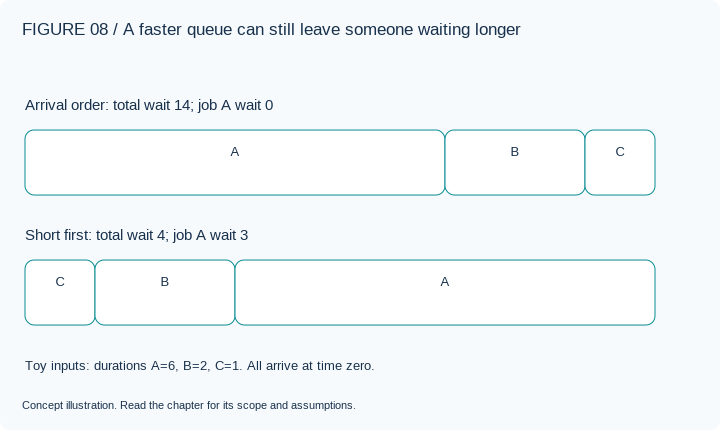
Conceptual explanation. The article states its assumptions and scope; illustrative inputs are identified within the figure.
Who waits when the order changes?
Toy calculation: A takes 6 time units, B takes 2 and C takes 1; all arrive at time zero. These are illustrative inputs, separate from the research dataset.
Basis and scope
Public explanatory note informed by exploratory UMT-Ω research drafts reviewed 27 October 2026. The underlying studies use synthetic constructions, are not peer reviewed or externally replicated, and do not evaluate the complete OMNI CORTEX architecture. No private draft or dataset is included here.