Take away three things
- A category is a navigation aid.
- Ask which representation is useful in this moment.
- Changing the explanation must preserve the evidence.
New website adaptation of the recovered book themes. The text here is newly written for this site.
Why we make maps
A map lets us see relationships that are difficult to hold in memory. It can show the overall subject, locate a decision or reveal a missing connection.
Every map selects what to include. Its value depends on the task and the person using it, so a clear route back to the underlying detail matters.
A person can need more than one view
Someone may want a whole-system picture first and a simple example next. The same person may prefer a short checklist when tired and a detailed technical explanation when ready to investigate.
A learner preference should remain revisable. The design question is what helps a person understand and act now, rather than assigning them to a fixed learning label.
Preserve the meaning
Alternative text, tables, diagrams and spoken explanations should retain the same important distinctions. A hypothesis stays a hypothesis when the paragraph becomes an infographic.
This connects the founder writing to Neuro Atlas: adapt the route into information while keeping its source, scope and uncertainty available.
Try it with a real task
Take one instruction and represent it as an overview, a worked example and one next action. Ask which version helps the person locate themselves and check the result.
The feedback is part of the design evidence. A pleasing visual is a starting point for that conversation.
The idea in one view.
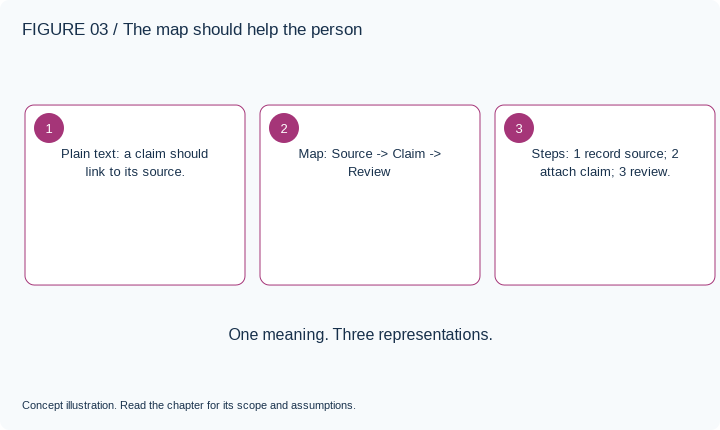
Conceptual explanation. The article states its assumptions and scope; illustrative inputs are identified within the figure.
Try three representations of one idea
The underlying idea stays the same: keep a claim connected to its source. This is a presentation demonstration, not a learner assessment.
Basis and scope
New website adaptation of themes recovered from the book project The Woman Who Asked Why and related founder writing. This is newly written editorial copy, not a verified passage from a latest manuscript.