Intelligence designed into reality
Brand and studio introduction · 12 seconds
Download short ↓Read transcript →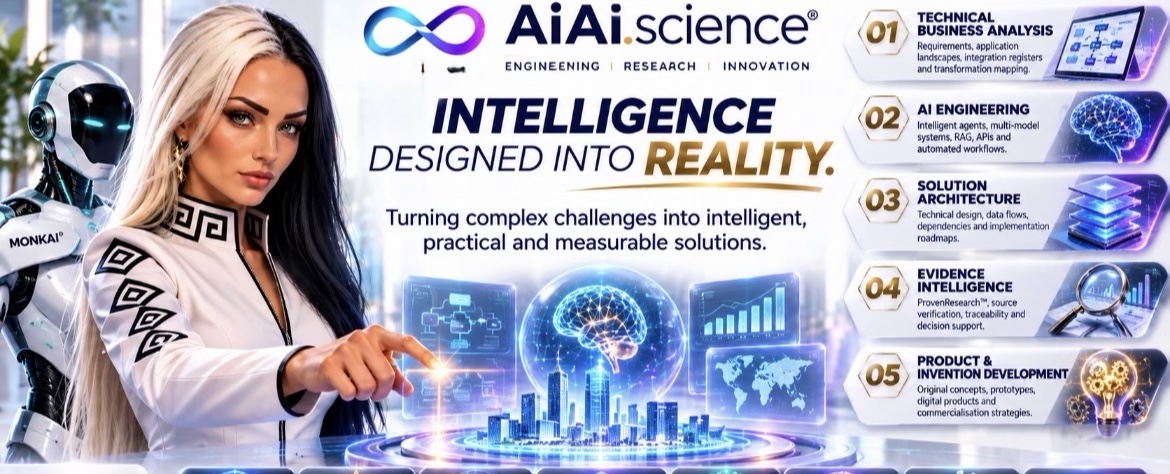
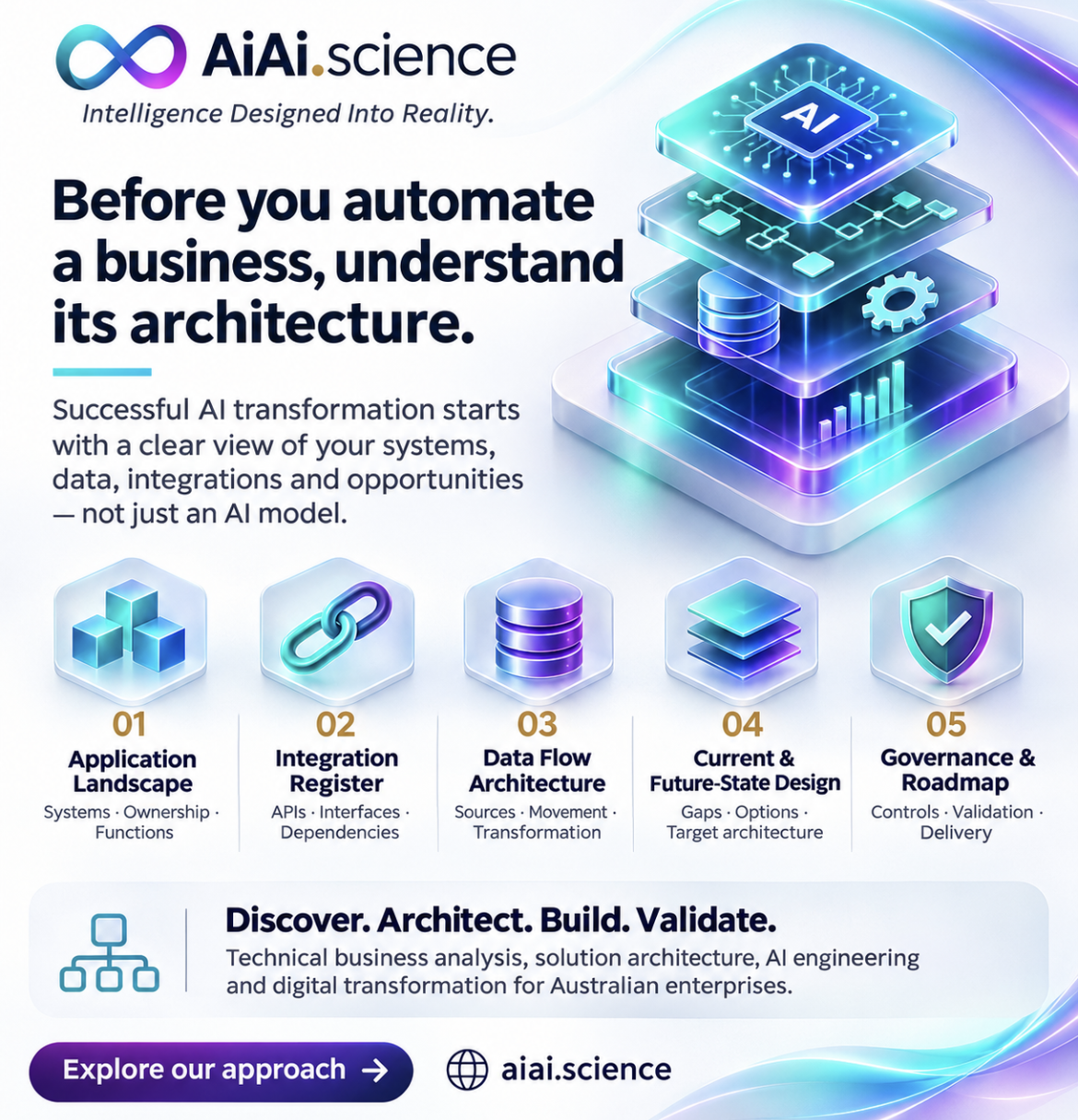
Discover, architect, build and validate. AiAi Science offers technical business analysis, solution architecture, AI engineering and digital transformation for Australian enterprises. The five work areas are the application landscape, integration register, data flow architecture, current and future-state design, and governance and roadmap.
Watch the AiAi.science introduction, explore the visual vision and follow selected research and architecture projects.

Start with the writing, inspect a research question or explore the architecture behind a practical application. Each route gives you context before the next decision.

Cross-domain AI coordination

Evidence and source tracing

Connected knowledge and records

Adaptive learning and navigation

Decision authority and approvals

Ideas to build-ready plans

Find and assess opportunities

Invention design and testing
 Explore service →
 Explore service →
 Explore service →
 Explore service →
I look at the relationships around a problem: the information, people, tools, constraints and decisions that shape what happens.
A repeated failure can be a local defect, a missing hand-off or a consequence of the way the wider system is organised. I first make that context visible.
From there, the work can become an evidence review, an architecture, a workflow redesign, a learning pathway or an invention proposal. The method is selected for the question and the outcome.
The handover should let someone else understand the reasoning: what was observed, what was proposed, what was tested and what still needs review.
Read the transformation-to-invention approach →Each creation addresses a different part of the work. Open one for its approach, a concrete example, its work products and a route to fuller reading.
Coordinate a complex question across disciplines while preserving evidence, uncertainty and authority.
Understand the role →02 · Evidence reviewPlatform prototypeAn evidence-intelligence system design for breaking questions into claims, tracing sources, comparing findings and making uncertainty visible.
Understand the role →03 · Knowledge continuityArchitectureA connected knowledge-and-work structure for linking projects, evidence, decisions, tools and outcomes so the context of work can travel with it.
Understand the role →04 · Tool connectionsArchitecture & development directionConnect tool capabilities with the authority and controls required to use them.
Understand the role →05 · Workflow entryArchitecture & development directionUse a scan to locate the right workflow, then establish identity, scope and permission.
Understand the role →06 · Decision and authorityArchitecture & development directionCompare feasible choices, then make authority and consequence explicit.
Understand the role →07 · Knowledge navigationFramework & interface conceptA framework for choosing how information is represented, sequenced and explained, so people can find a useful route into a complex topic.
Understand the role →08 · Learn and practiseLearning framework & prototype workTeach the next useful step at the learner’s pace, with a way to check understanding.
Understand the role →09 · Stepwise guidanceSelf-contained educational prototypeKnow where you are, what to do next, what should happen and how to recover.
Understand the role →10 · Process transformationArchitecture & development directionUnderstand what to preserve, improve, connect or redesign.
Understand the role →11 · Gap investigationArchitecture & development directionInvestigate a gap before treating it as an opportunity.
Understand the role →12 · Mechanism developmentArchitecture & development directionTurn a demonstrated problem into a mechanism that can be examined and tested.
Understand the role →13 · Engineering and safetyEngineering blueprintAn engineering-safety intelligence direction for organising construction plans, constraints, hazards and controls into reviewable work processes, alongside a proposed AI Chief Engineer for mathematical and safety review.
Understand the role →14 · Historical optionsPublic workspace · evolving systemA legal-information system concept for reconstructing which options existed at a decision point and what evidence supports each part of that account.
Understand the role →15 · Visual learningLearning prototypeVisual and pace-adaptive learning system designs for helping people connect complex ideas, see the wider structure and learn through clear steps.
Understand the role →16 · Creation journeyInteractive conceptA guided workbench for moving from a problem or opportunity through research, constraints, opportunity mapping and a build-ready product plan.
Understand the role →17 · Life coordinationInterface conceptA life-organisation concept that connects forms, documents, contacts, planning and personal assets in one clear operating view.
Understand the role →18 · Capability selectionCatalogue prototypeA searchable AI-tool landscape that organises options by category and source to make comparison and selection easier.
Understand the role →19 · AI workspaceWorkspace conceptA workspace concept for organising AI accounts, projects, custom instructions, live threads, skills and code or document work in one navigable environment.
Understand the role →Choose the work product your situation needs: an inspectable research brief, a connected architecture, a clearer process or a bounded product plan. Each service page explains the approach and deliverables.
Problem framing, system maps, data and tool flows, agent boundaries, integration plans and technical specifications.
View service →Find repeatable work, design the hand-offs, select fit-for-purpose tools and map approvals, exceptions and human review.
View service →Structured research, claim and source registers, evidence synthesis, uncertainty notes and traceable decision briefs.
View service →Practical permission boundaries, approval gates, audit trails and escalation paths for AI-assisted processes.
View service →Turn an early idea into a product brief, user journey, architecture, prototype plan, roadmap and testable assumptions.
View service →Organise scattered work into a usable taxonomy, searchable knowledge base, evidence portfolio or invention register.
View service →An original six-page portfolio shows the documentation method: discovery, interface mapping, technical assurance and a proposed engagement sequence.
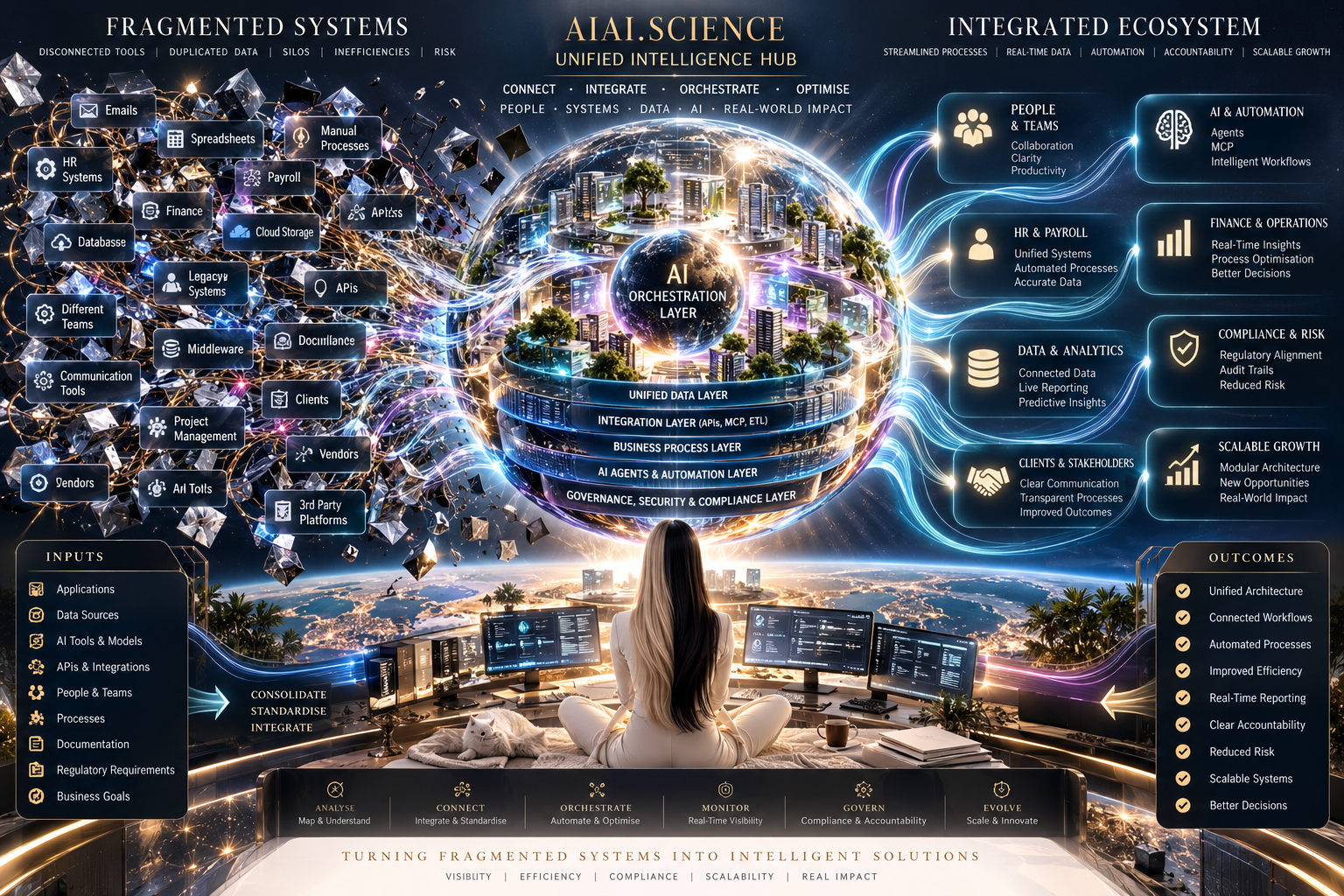
Application discovery, integration mapping, multi-agent architecture and the records that make a system understandable.
Read the overview & open the portfolio →Five accessible notes from the latest recovered exploratory work: evaluation boundaries, uncertainty, source dependence, causal assumptions and operational trade-offs.
A closer look at the unit of evaluation: new records can still belong to familiar groups.
Read the full piece →Research notesAn overall reliability measure can hide differences between subgroups and between operating conditions.
Read the full piece →Research notesEvidence needs an origin map: copies and genuinely independent observations should be handled differently.
Read the full piece →Research notesDifferent mechanisms can explain the same observations while predicting different consequences of an intervention.
Read the full piece →Research notesOperational improvement is a collection of objectives: total waiting, individual delay, deadlines and legitimate priorities.
Read the full piece →These public notes explain questions examined in synthetic exploratory studies. They are not peer-reviewed results, real-world performance estimates or validation of the complete OMNI CORTEX system.
Explore the purpose, method, examples and work products behind the existing portfolio and technical summaries. The original architecture portfolio is available as a PDF.
A repeatable path from problem and pattern to system, evidence, product and value.
Read public summary → Canonical architecture paperA cross-domain operating system linking research, architecture, invention, engineering and commercial translation.
Read public summary → Technical validation reportA claim-by-claim feasibility, prior-art, governance and procurement reality check.
Read public summary → Preregistration-ready research protocolA falsifiable comparison of audit answerability against BPMN and W3C PROV baselines.
Read public summary → Engineering build specificationA build-oriented specification connecting architecture, safety boundaries, tests and verifiable engineering work products.
Read public summary →Questions, patterns, purpose and the way we make sense of complexity. These new website adaptations connect the recovered book themes to the practical work.
A takeaway from the writing behind the work: a persistent question can become the beginning of a disciplined investigation.
Read the full piece →Book themesHow reflection can become a design principle, and how a design principle can become a testable piece of work.
Read the full piece →Book themesStructure can make complexity understandable while leaving room for context, choice and different ways of learning.
Read the full piece →A question can become a pattern. A pattern can become a design. The design should give us something useful to test.
Explore the book takeaways →The curriculum, the explanation and the companion have distinct roles. Together, the design connects a learning goal with practice, feedback and a way to recover.
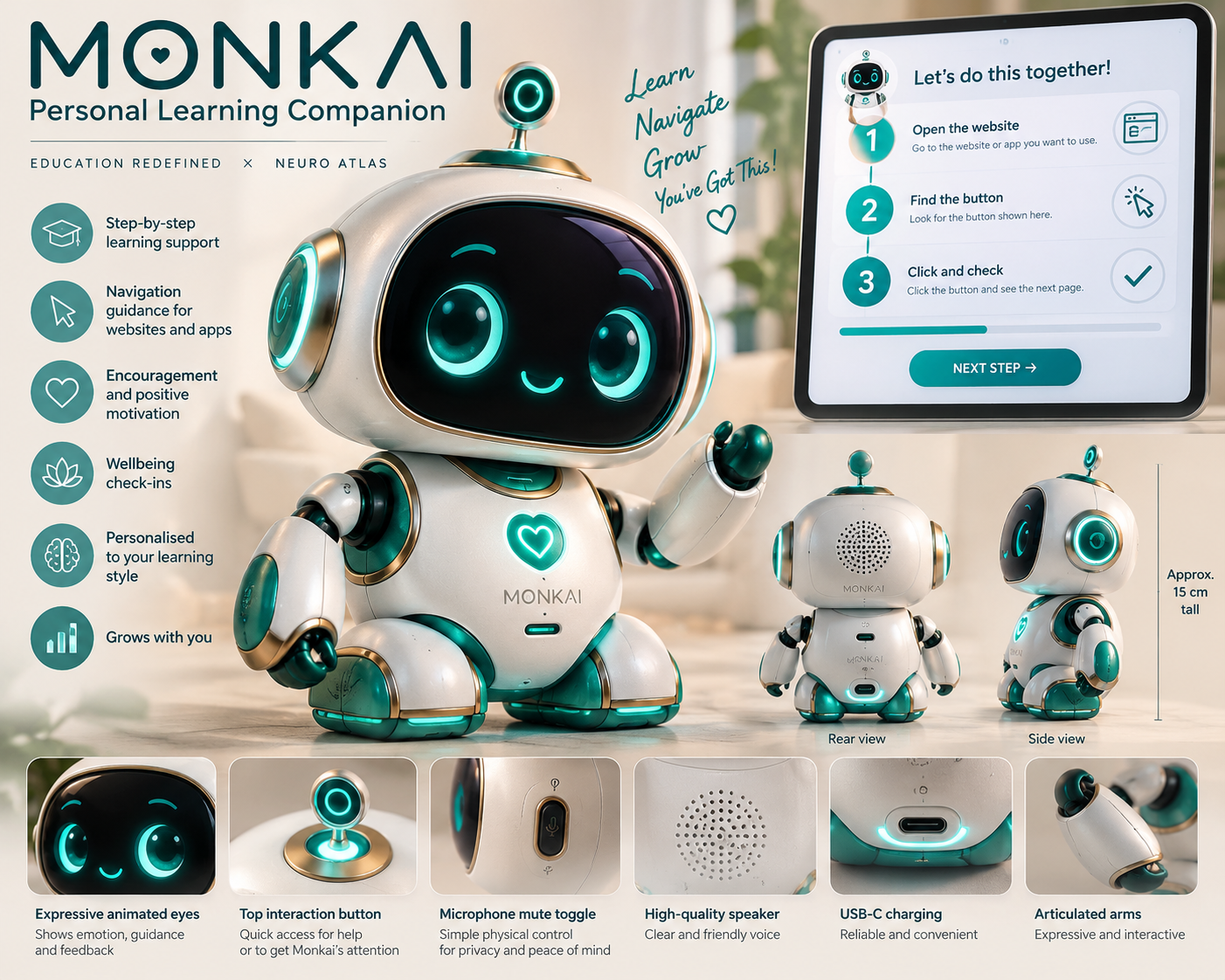 Jessica & Monkai · Navigation Academy
The October blueprint and digital prototype connect each action with its purpose, expected result and recovery path. Pictured robot hardware is a design concept.
Explore the academy approach →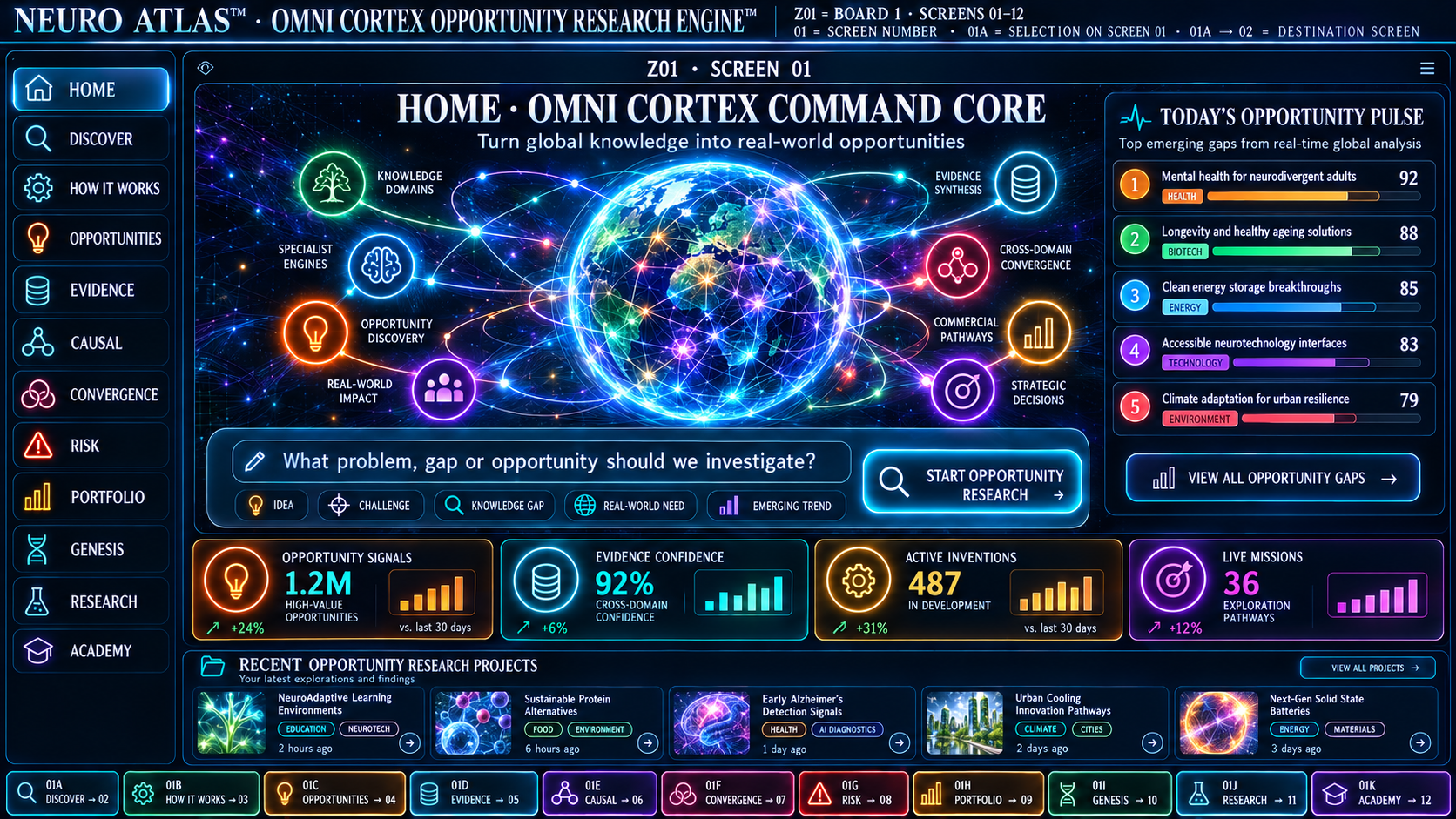 Education Redefined + Noah
Noah carries the later learning direction developed through earlier Bella work. Neuro Atlas shapes presentation, pacing and focus, while the lesson retains its goal and evidence.
Explore the learning model →The underlying idea stays the same: keep a claim connected to its source. This is a presentation demonstration, not a learner assessment.
Device, equipment and engineering concepts connect digital decisions with real materials, machinery and working conditions.
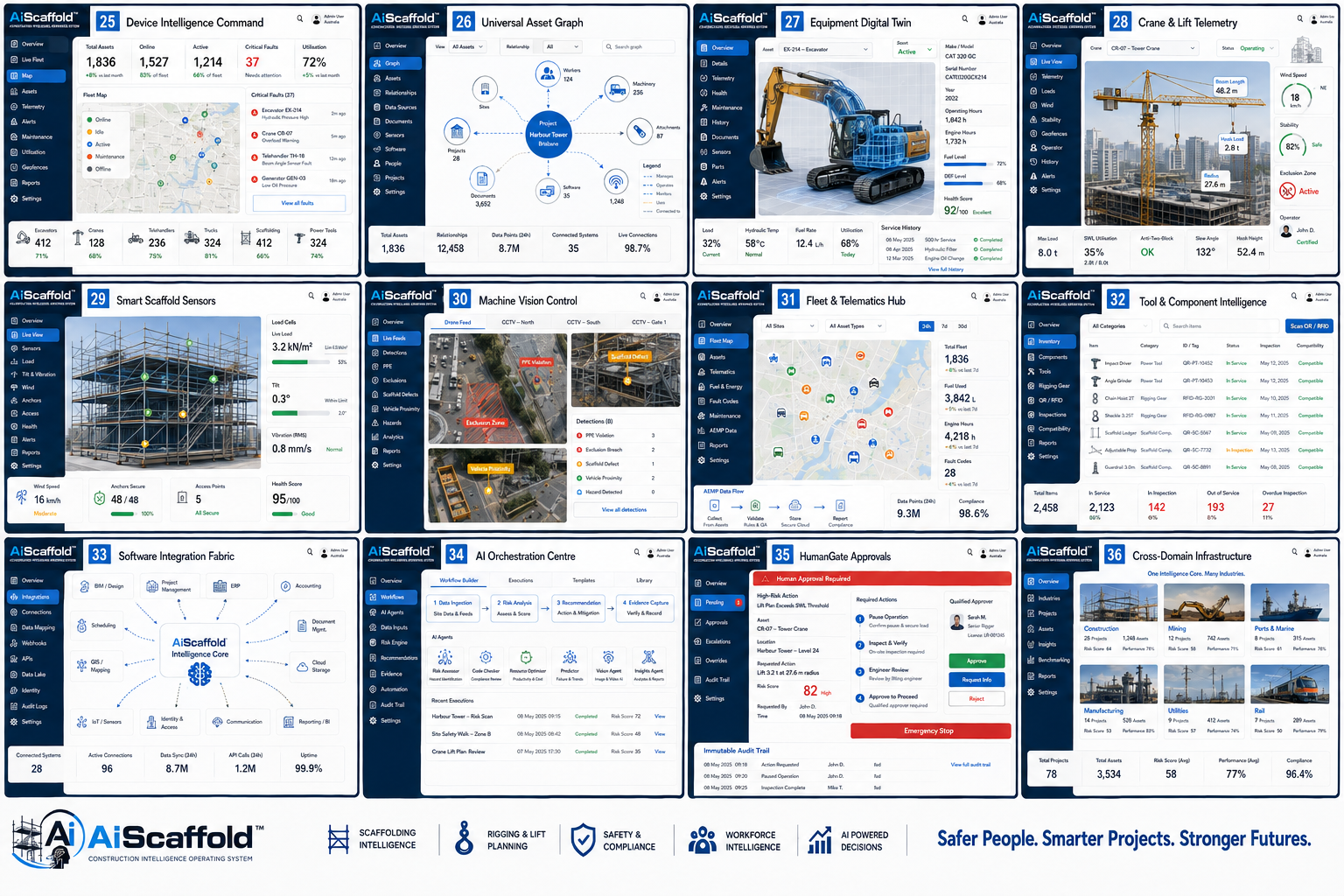 AISCaffold · Device & equipment concepts
Explore the device and sensor design direction: equipment twins, scaffold sensing, telemetry and accountable review.
Explore the physical design direction → RAM-X OmniStudio · Engineering blueprintA proposed system for assigning authorised devices to work they can perform, with attention to compatibility, energy, privacy and cost.
Explore RAM-X →Three vertical motion shorts from the AIAI.science visual world. Play, pause or download a copy.
30-second introduction · Silent motion sequence from concept artwork
Brand and studio introduction · 12 seconds
Download short ↓Read transcript →Connected intelligence · 12 seconds
Download short ↓Read transcript →Neuro Atlas learning direction · 12 seconds
Download short ↓Read transcript →A focused engagement is organised around visible outcomes at every stage, so you can see what has been clarified, designed, created and proven.
Outcome: the real problem, users, constraints, available evidence and success measure are written down.
Explore discovery → 02 · MAPOutcome: a connected map of components, workflows, data, responsibilities and decision gates.
Explore architecture → 03 · CREATEOutcome: the agreed prototype, automation plan, evidence pack, interface or product blueprint.
Explore creation → 04 · HAND OVEROutcome: acceptance checks, limitations, documentation and prioritised next-release actions.
Explore validation →Typical sequence only. Timing and deliverables are agreed before work begins and depend on complexity, access to information and review requirements.